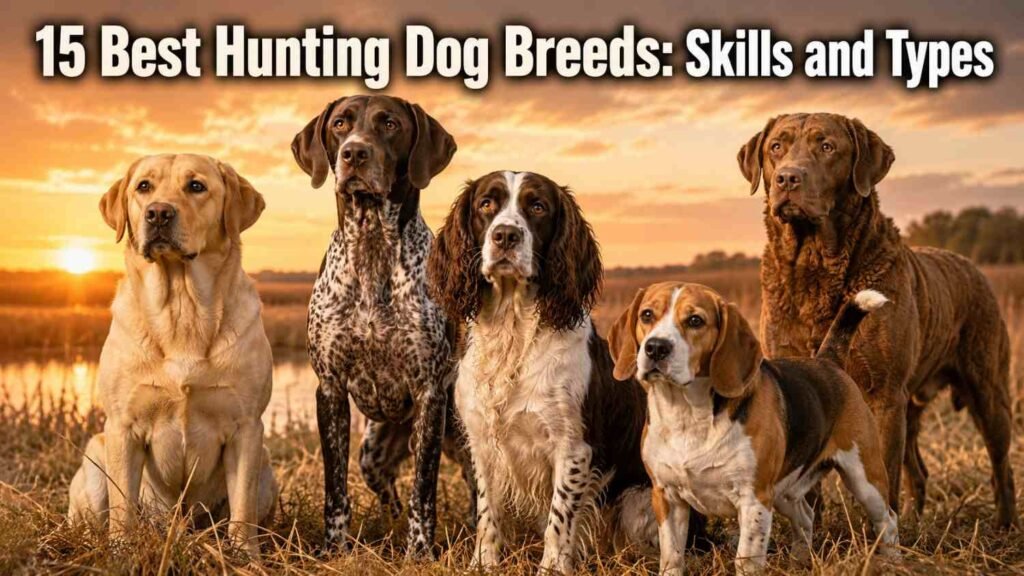
Choosing a hunting dog isn’t like choosing a new jacket or pair of boots. A dog will share your home, demand daily care, and work beside you for years. The best choice must therefore fit both your hunting style and your ordinary life.
The right hunting dog breeds differ depending on whether you pursue ducks in cold water, pheasants in grassland, grouse in tight cover, rabbits through brush, or raccoons after dark. Some dogs retrieve fallen birds. Others point, flush, trail, or tree game. Even two dogs from the same breed can work differently because of breeding, temperament, training, and experience.
Hunting also remains a major outdoor activity in the United States. The latest national survey from the U.S. Fish and Wildlife Service found that 14.4 million Americans aged 16 or older hunted in 2022 and took 165 million hunting trips. For many of those hunters, a reliable dog is more than a tool. It’s a teammate, travel companion, and member of the family.
This guide explains the main types of hunting dogs, compares 15 strong breed choices, and shows you how to match a dog to your game, terrain, experience, climate, and home.
What Makes a Great Hunting Dog?
A great hunting dog needs more than speed or a powerful nose. The dog must combine natural ability with cooperation. A dog that can locate a bird but ignores every command may create more problems than it solves. In the same way, a perfectly obedient dog with little hunting desire may struggle to search independently in difficult cover.
The most valuable field traits include prey drive, scenting ability, stamina, trainability, confidence, persistence, and a willingness to work with the handler. The exact balance changes with the job. A pointing dog may need enough independence to search a large field, while a flushing spaniel must usually remain within effective range of the hunter. A retriever needs marking ability and the desire to enter water, while a scent hound must stay committed to a trail.
Temperament matters just as much. Most owners spend far more days at home than in a duck blind or upland field. A dog that hunts well but can’t settle indoors, tolerate visitors, or live safely around other pets may be a poor match for your household.
Professional testing can help owners assess these qualities. AKC retriever hunt tests, for example, evaluate marking, hunting style, perseverance, courage, steadiness, control, response, and delivery. NAVHDA also provides progressive tests for versatile hunting dogs, beginning with inherited natural ability and advancing toward finished field performance.
Breed gives you a useful starting point, but it doesn’t guarantee performance. Think of breed as the design of a truck: it tells you what the vehicle was built to do. Breeding quality, training, conditioning, and handling determine how well it performs on the road.
Main Types of Hunting Dogs

The American Kennel Club identifies retrievers, pointers, setters, and spaniels as the four basic types within its Sporting Group. Hounds form another major hunting category and commonly locate game through scent. Understanding these working styles should come before choosing a specific breed.
Retrievers
Retrievers locate and bring back downed game, especially birds. They need a strong desire to retrieve, good memory for where a bird fell, confidence in water, and a gentle grip that doesn’t damage game. Labrador Retrievers, Golden Retrievers, and Chesapeake Bay Retrievers are familiar examples.
A retriever is often the natural choice for a waterfowl hunter. However, many retrievers can also quarter through upland cover, flush birds, and recover pheasants or grouse. Their cooperative nature can make some retriever breeds easier for first-time handlers, although their energy and training needs remain substantial.
Pointers and Setters
Pointing dogs search for upland birds and freeze when they locate scent. Their still posture tells the hunter where the bird is holding. Setters perform a similar job and were historically developed to “set” or crouch near game.
These dogs vary in range. Some stay relatively close, while others sweep across large fields. Hunters who work open prairie may prefer a wider-ranging dog. Someone hunting grouse in thick woods may want a dog that checks in frequently and works at a closer distance.
German Shorthaired Pointers, Brittanys, Vizslas, and English Setters are popular examples. Several continental pointing breeds can also retrieve on land or water, making them valuable to hunters who pursue more than one type of game.
Flushing Spaniels
Flushing dogs search cover close to the hunter and push birds into the air. They don’t normally hold a point. Their job is to locate hidden birds, force them to fly within range, and often retrieve them after the shot.
English Springer Spaniels and Boykin Spaniels are classic choices. Their compact builds allow them to move through brush, cattails, and tangled vegetation. Good flushing dogs require careful control because a dog that races too far ahead may flush birds outside effective range.
Scent Hounds
Scent hounds follow ground or air scent to locate game. Beagles traditionally pursue rabbits or hare, while coonhounds trail animals and alert the hunter through distinctive vocalizations.
These dogs often work more independently than gun dogs. That independence can be valuable on a difficult trail, but it also makes secure containment and recall training important. Many scent hounds are vocal, highly food-motivated, and determined to follow an interesting smell. A normal backyard fence can become a serious weakness when a hound catches scent on the other side.
Quick Comparison of the 15 Best Hunting Dog Breeds
The following table provides a starting point rather than a final verdict. Individual dogs and bloodlines vary, so speak with experienced handlers and breeders before making a decision.
| Breed | Hunting Type | Best-Suited Work | Typical Handler Fit | Important Consideration |
| Labrador Retriever | Retriever | Ducks, geese, upland retrieval | Beginner to experienced | High exercise needs and heavy shedding |
| Chesapeake Bay Retriever | Retriever | Cold-water waterfowl | Intermediate to experienced | Strong, determined personality |
| Golden Retriever | Retriever | Waterfowl and upland retrieval | Beginner to experienced | Coat needs regular care |
| German Shorthaired Pointer | Versatile pointer | Upland birds and retrieving | Active intermediate handler | Extremely energetic |
| German Wirehaired Pointer | Versatile pointer | Mixed game and harsh cover | Experienced active handler | Needs structured training |
| Vizsla | Pointer and retriever | Upland birds | Active, involved handler | Forms a very close human bond |
| Weimaraner | Versatile gun dog | Upland work and tracking | Experienced active household | Can struggle without company and activity |
| English Setter | Setter | Grouse, quail, and pheasant | Patient upland hunter | Feathered coat collects debris |
| Brittany | Versatile pointing dog | Upland birds | Beginner to intermediate | Needs substantial daily activity |
| English Springer Spaniel | Flusher and retriever | Pheasant, grouse, and woodcock | Beginner to experienced | Working lines may be very intense |
| Boykin Spaniel | Flusher and retriever | Ducks and upland birds | Active intermediate handler | Coat and ears need field care |
| American Water Spaniel | Water retriever and flusher | Small boats, marshes, upland work | Active intermediate handler | Relatively uncommon breed |
| Beagle | Scent hound | Rabbits and hare | Beginner with secure property | Strong urge to follow scent |
| Treeing Walker Coonhound | Treeing scent hound | Raccoon and other treeing work | Experienced hound handler | Covers ground quickly and can be loud |
| Bluetick Coonhound | Scent hound | Persistent trailing and treeing | Experienced hound handler | Powerful prey drive and vocal nature |
15 Best Hunting Dog Breeds and Their Field Skills

1. Labrador Retriever
The Labrador Retriever is one of the most adaptable choices for hunters who want a capable field dog and social household companion. Labs are strongly associated with retrieving and swimming, making them natural candidates for duck and goose hunting. Many also work upland cover and recover pheasants, grouse, or other birds.
Their trainability and desire to interact with people can help a new handler, but a young working-bred Lab is rarely a low-energy pet. It needs daily physical exercise, retrieving drills, obedience, and mental work. Without structure, that enthusiasm may appear as jumping, chewing, pulling, or endless demands for play.
Choose a breeder whose dogs demonstrate the type of work you intend to do. A puppy from proven hunting or hunt-test parents gives you more useful information than coat color alone. The Labrador’s national breed standard also emphasizes its original role as a working gun dog.
Best for: Waterfowl hunters, mixed upland and waterfowl homes, and first-time handlers prepared to train consistently.
2. Chesapeake Bay Retriever
The Chesapeake Bay Retriever was developed around the demanding waterfowl conditions of the Mid-Atlantic. Its dense, weather-resistant coat and tireless working style make it especially attractive to hunters facing cold water, wind, mud, and difficult retrieves. The AKC describes the breed as an American duck dog known for loyalty, determination, and a waterproof coat.
A Chessie may be more independent and serious than the average Labrador. That isn’t a flaw; it’s part of what can make the dog persistent in harsh conditions. It does mean that inconsistent handling or repetitive training may create conflict. Calm leadership, clear rules, and purposeful sessions usually work better than force or constant drilling.
This breed is often best for someone who values toughness and commitment over easygoing sociability. Early socialization matters, particularly if the dog will live around frequent visitors, children, or other animals.
Best for: Dedicated waterfowl hunters, cold climates, rough water, and handlers who appreciate a strong-minded dog.
3. Golden Retriever
The Golden Retriever is sometimes viewed only as a family pet, but it was developed as a gundog and remains capable of serious hunting and field work. Goldens tend to be cooperative, people-focused, and willing to retrieve. These qualities can suit hunters who want a dog that moves easily between field work and family life.
A properly bred field Golden can retrieve waterfowl, work upland cover, and participate in hunt tests. Working-oriented Goldens may be leaner, faster, and more energetic than the heavier-coated dogs many people picture. Prospective buyers should therefore evaluate the actual parents and bloodline rather than relying on the breed’s general reputation.
The coat requires more maintenance than a short-haired retriever’s coat. Burrs, mud, seeds, and ice can collect in feathering, so post-hunt inspection and grooming are essential.
Best for: Family-oriented hunters who want an affectionate, trainable retriever and don’t mind coat care.
4. German Shorthaired Pointer
The German Shorthaired Pointer is a versatile gun dog designed to handle several jobs. It can search, point, retrieve, and work across varied terrain. The breed’s athletic build and high drive make it popular among hunters who spend long days pursuing pheasant, quail, grouse, and other upland birds.
This isn’t usually a good choice for a household seeking a relaxed dog that will be satisfied with a short walk. A GSP needs vigorous exercise and a constructive outlet for its brain. Running alone isn’t always enough. The dog also benefits from scent work, retrieving, obedience, field exposure, and problem-solving activities.
Its short coat is easy to maintain but offers less insulation than the coats of some cold-weather breeds. In colder conditions, handlers must monitor the dog closely and use appropriate protection when necessary.
Best for: Highly active upland hunters who want one dog capable of pointing and retrieving.
5. German Wirehaired Pointer
The German Wirehaired Pointer combines versatile hunting ability with a coarse, weather-resistant coat. It was designed for outdoor work and can perform across upland fields, wetlands, brush, and changing weather. The breed’s sturdy build and protective coat can be advantageous where thorns, cold, or rough vegetation challenge a short-haired dog.
Wirehairs often bring confidence, persistence, and a strong personality to the job. They usually do best with handlers who establish clear expectations early and provide regular work. A bored Wirehair may invent its own activities, and those activities may involve digging, chasing, guarding, or dismantling household objects.
For the right owner, the breed offers impressive range. It can point birds, retrieve, track, and adapt to different hunting situations. For the wrong owner, its energy and independence can become exhausting.
Best for: Experienced hunters who need a rugged, versatile dog for mixed terrain and weather.
6. Vizsla
The Vizsla is a sleek Hungarian gun dog developed for long days in the field. It points, retrieves, and tends to maintain a strong connection with its handler. This combination makes it appealing to hunters who enjoy an athletic dog that works as part of a close team rather than disappearing across the horizon.
Vizslas are often described as intensely people-oriented. Many want to remain physically close to their owners at home. That closeness can improve communication in the field, but it also means the breed may struggle in a home where it’s left alone for long periods.
Its short coat is convenient in warm conditions and easy to clean after a dry-field hunt. It provides limited protection in severe cold or heavy cover, however. Conditioning, weather awareness, and suitable gear become important when temperatures fall.
Best for: Active upland hunters who want an affectionate, responsive dog with a close-working relationship.
7. Weimaraner
The Weimaraner is a fast, athletic German hunting breed with a strong desire for activity and human companionship. Historically valued by hunters, the breed can work upland birds, retrieve, and use its nose for tracking tasks. The AKC highlights its speed, obedience potential, and need for plenty of exercise and quality time with people.
A Weimaraner’s intelligence doesn’t mean it will automatically obey. Smart dogs quickly learn both good and bad habits. Training must be consistent, rewarding, and challenging enough to hold the dog’s attention. Owners also need to teach calm indoor behavior rather than assuming hard exercise will solve everything.
Because Weimaraners often bond closely with their families, gradual independence training is important during puppyhood. A well-prepared Weimaraner can be a striking and effective partner, but the breed is demanding for a casual owner.
Best for: Experienced, athletic owners who hunt regularly and want an intensely involved companion.
8. English Setter
The English Setter is a traditional upland bird dog known for an elegant search, pointing instinct, and gentle expression. It was developed to work varied British terrain and remains a respected option for quail, grouse, pheasant, and similar game.
Field-bred English Setters may differ significantly from heavily coated show dogs. Serious hunters should look for dogs from lines that match their preferred range and terrain. A wide-ranging prairie dog may frustrate someone hunting tight woodland cover, while a close-working dog may not satisfy a horseback hunter covering open country.
The feathered coat needs inspection after every outing. Grass seeds, burrs, small sticks, and mud can hide around the ears, legs, feet, and tail. Regular brushing and trimming in practical areas can reduce problems.
Best for: Upland hunters who value style, pointing ability, and a generally gentle companion.
9. Brittany
The Brittany is compact, agile, energetic, and highly respected as a versatile bird dog. Although its appearance resembles that of a spaniel, its hunting style is that of a pointing breed. It can search efficiently, point birds, and retrieve, all while taking up less physical space than many larger gun dogs.
That smaller frame makes the Brittany convenient for travel, smaller homes, and hunters who don’t want a large dog in the vehicle or house. Small doesn’t mean calm, though. Brittanys are tireless in the field and need frequent exercise, training, and interaction.
Many are sensitive and respond best to clear, encouraging instruction. Heavy-handed correction can damage confidence. A thoughtful handler who builds skills step by step may find the Brittany both manageable and highly capable.
Best for: Upland hunters seeking a compact, eager, versatile pointing dog.
10. English Springer Spaniel
The English Springer Spaniel is a close-working flushing dog built to find birds hidden in dense cover. A trained Springer quarters in front of the gun, uses scent to locate game, flushes it, and may retrieve after the shot. The breed is known for energy, stamina, intelligence, and the ability to serve as both a hunting partner and household companion.
Buyers should understand the difference between field and bench lines. The English Springer Spaniel Field Trial Association explains that field-bred dogs are selected for active hunting performance and commonly have leaner builds, shorter coats, and high working energy.
Range control is essential. A Springer that pushes too far ahead can flush birds before the hunter is ready. Whistle commands, recall, directional handling, and steadiness should be built gradually.
Best for: Pheasant, grouse, and woodcock hunters who work brush, woodland, or thick grass.
11. Boykin Spaniel
The Boykin Spaniel is a medium-sized American breed developed to flush and retrieve. Its manageable size made it useful in small boats, while its enthusiasm allowed it to work marshes and upland cover. The breed is known for a rich brown coat, trainability, and a combination of household friendliness and field determination.
A Boykin can be a practical choice for hunters who want something smaller than a Labrador without giving up water work. The dog still requires serious exercise and training. “Smaller” should never be confused with “low maintenance.”
Its ears and coat deserve attention after wet or muddy hunts. Owners should dry the dog thoroughly, check the ear canals and skin, and remove plant material from the coat.
Best for: Hunters using small boats, Southern waterfowl hunters, and upland hunters who prefer a compact retriever-flusher.
12. American Water Spaniel
The American Water Spaniel originated in the lake country of the upper Midwest. It was built as a compact hunting and swimming dog that could work from a boat while also flushing and retrieving on land. The breed remains a useful option for hunters who need versatility in a smaller package.
These dogs are active, eager, and capable of working in wet environments, but they can also have an independent streak. Consistent positive training and early exposure to boats, water, cover, decoys, and field noises help build confidence.
Because the breed is less common than the Labrador or Springer, finding a suitable breeder may take time. That delay is preferable to choosing a litter without enough information about health, temperament, or working ability.
Best for: Midwestern hunters, small-boat waterfowlers, and owners seeking an uncommon multipurpose spaniel.
13. Beagle
The Beagle is a compact scent hound traditionally bred to hunt in packs. It excels at following rabbit or hare scent through cover and communicating through its voice. Beagles are also known for an easygoing social nature, partly connected to their history of working with other dogs.
A Beagle’s nose can overpower its interest in the owner. When a promising scent crosses the trail, recall that seemed perfect in the yard may suddenly disappear. Secure fencing, identification, tracking equipment where legal and appropriate, and careful field conditioning are important.
Their size and friendly personality make Beagles attractive family dogs, but their vocal behavior may not suit every neighborhood. Owners should also watch food intake because many Beagles are enthusiastic eaters.
Best for: Rabbit and hare hunters who enjoy working with scent hounds or small packs.
14. Treeing Walker Coonhound
The Treeing Walker Coonhound is a fast, determined American hound capable of covering substantial ground. It trails game and uses its voice to communicate progress to the handler. Once quarry is treed, the dog continues alerting until the hunter arrives. The AKC describes the breed as smart, brave, sensible, and much faster than its name might suggest.
This is not usually an apartment-friendly choice. The breed needs room, secure containment, structured exercise, and an owner who understands hound behavior. Its voice is useful in the woods but may cause problems in a closely packed neighborhood.
A Treeing Walker may be affectionate at home, yet its hunting instinct remains powerful. Introductions to cats and small pets require caution, and off-leash freedom outside controlled areas can be risky.
Best for: Experienced hound hunters pursuing raccoon or other legal treeing quarry across large areas.
15. Bluetick Coonhound
The Bluetick Coonhound is a bold and persistent scent hound known for remaining focused when pursuing quarry. The breed may be affectionate and relaxed during quiet periods, but its prey drive becomes intense once it begins working a trail.
Like other coonhounds, the Bluetick communicates through a strong voice. That voice is part of the working system, not a minor habit that can simply be removed. Prospective owners should consider their property, neighbors, fencing, and local rules before bringing one home.
The breed suits handlers who enjoy the independence and problem-solving style of a true scent hound. Someone expecting retriever-like obedience at every moment may become frustrated. Training should build cooperation without trying to erase the qualities that make the dog effective.
Best for: Experienced handlers who need a committed trailing and treeing hound.
How to Choose the Right Hunting Dog Breed
Don’t begin by asking, “Which breed looks best?” Begin with, “What job will this dog perform most often?” Your honest answer immediately removes many poor matches.
A Labrador may be a wonderful dog, but it isn’t automatically the best choice for every rabbit hunter. A Treeing Walker may be outstanding in the woods, but it’s a difficult choice for a quiet suburban household. The best dog is the one whose daily needs and natural working style match what you can actually provide.
Match the Dog to Your Game, Terrain, and Climate
Start with the game you hunt most frequently.
For ducks and geese, look closely at retrievers and water spaniels. Consider water temperature, boat size, retrieve distance, current, ice, and the dog’s physical protection from cold.
For pheasant in grass or cattails, a close-working flusher or versatile pointing dog may be appropriate. For quail on open land, you may prefer a pointing breed with more range. For grouse or woodcock in tight woods, communication and a manageable search pattern become especially important.
Rabbit hunters normally need a scent hound rather than a pointing dog. Coon hunters need dogs bred and trained for trailing and treeing. Trying to force a breed into a completely different job is like using a bass boat in a mountain stream: it may technically float, but it isn’t the right design.
Climate also matters. A heavy, weather-resistant coat helps in cold water but may require careful heat management during warm early-season hunts. A thin-coated dog may work comfortably in warm, dry terrain yet need protection during freezing conditions.
Match Energy, Temperament, and Home Life
Now examine your ordinary week—not your most ambitious hunting weekend.
How many hours can you devote to the dog every day? Do you have safe space for off-leash exercise? Will the dog live indoors? Are there children, cats, poultry, or other dogs in the household? How much barking can your neighbors tolerate?
Most sporting breeds need more than a slow walk around the block. They often require aerobic exercise, obedience, retrieving, scent work, and regular opportunities to use their brains. Strong prey drive is natural in hunting breeds and should be channeled through training rather than treated as bad behavior.
Be honest about your patience as well. A highly sensitive dog may shut down under harsh correction. An independent hound may test a handler who expects instant compliance. A strong retriever may overwhelm an owner who hasn’t taught leash manners.
A practical example is a hunter who pursues ducks six weekends a year but works long hours and lives in a small apartment. The decision shouldn’t be based only on those six weekends. The owner must choose a dog whose needs can be met during the other 46 weeks.
Check Working Ability, Breeder Quality, and Health Testing
Breed name alone doesn’t prove that a puppy will hunt. Ask what the parents actually do. Have they hunted wild birds? Completed hunt tests? Participated in field trials? Passed a versatile-dog test? Are videos, records, or references available?
Performance titles aren’t mandatory, but they provide useful evidence. They show that someone has evaluated the dog’s abilities outside the breeder’s backyard. The type of test also matters because pointing, spaniel, retriever, and hound programs evaluate different skills.
Ask the breeder:
- What game and terrain do the parents hunt?
- How far do they range?
- How do they behave in the house?
- Are they comfortable around people and other dogs?
- Which breed-specific health tests were completed?
- Can you verify the results independently?
- How are puppies socialized?
- How does the breeder match puppies with buyers?
- Will the breeder take the dog back if the placement fails?
The OFA works with parent clubs to identify breed-specific screening recommendations. Prospective owners can use the OFA breed-health database to research common concerns and verify available records. A CHIC number indicates that required results were made public; it doesn’t mean every result was normal, so buyers should review the actual findings.
Avoid choosing a puppy based only on color, sex, the largest body, or the puppy that runs toward you first. Experienced breeders observe the litter over time and are often better positioned to match energy, confidence, independence, and temperament with the right home. Puppy temperament testing can offer information, but it doesn’t perfectly predict adult behavior.
Training, Safety, and First-Season Preparation
Training begins long before the first live hunt. The puppy must learn that you’re dependable, commands have meaning, and new environments are safe. Early sessions should be short, clear, and enjoyable. Building enthusiasm is usually more productive than demanding polished performance too soon.
Before hunting, develop reliable responses to:
- Recall: The dog returns immediately despite distraction.
- Sit or stay: The dog can remain controlled near activity.
- Heel: The dog travels safely beside you when required.
- Leave it or drop: The dog releases unsafe or unwanted objects.
- Kennel: The dog enters a crate, vehicle kennel, or boat calmly.
- Directional handling: The dog responds to whistles, hand signals, or casting commands appropriate to its job.
- Steadiness: The dog doesn’t break dangerously when birds flush or shots are fired.
Gunfire introduction must be gradual and properly timed. Firing a loud gun near an unprepared puppy can create lasting fear. Begin with distance, positive associations, and guidance from an experienced trainer or club. Don’t rush simply because hunting season is approaching.
Field safety also includes conditioning. A dog that spends summer on the couch shouldn’t be expected to hunt hard all day in October. Increase activity gradually, monitor paws, keep nails in working condition, and consult a veterinarian about body condition, hydration, parasite prevention, vaccinations, and the physical demands of your intended hunts.
Pack water, a collapsible bowl, a first-aid kit, identification, waste bags, a towel, and any legally permitted tracking or location equipment you use. A visible orange vest can help other hunters see the dog in cover. AKC field-safety guidance recommends making the dog easy to identify and preparing necessary supplies before going afield.
After every hunt, check:
- Paw pads and nails
- Eyes and ears
- Armpits and groin
- Coat and skin
- Ticks, burrs, seeds, and thorns
- Signs of overheating, chilling, lameness, or exhaustion
Common mistakes to avoid include expecting breed instinct to replace training, introducing gunfire too quickly, allowing uncontrolled chasing, hunting an unconditioned dog, ignoring recall problems, and choosing a puppy without verifying health or working background.
Joining a training group can shorten the learning curve. NAVHDA chapters, AKC clubs, retriever clubs, spaniel clubs, pointing-dog groups, and local hound organizations may offer training days, tests, and access to experienced handlers. These settings also let you observe multiple breeds before committing to one.
Conclusion: Choose the Partner, Not Just the Breed
There is no universal winner among the best hunting dog breeds. A Labrador may be ideal for one duck hunter, while another needs the cold-water toughness of a Chesapeake Bay Retriever. A Brittany may fit an upland hunter who wants a compact pointing dog, while an English Springer Spaniel may better suit someone who prefers close flushing work. Rabbit and coon hunters need an entirely different set of instincts.
Your decision should begin with game, working style, terrain, climate, training experience, and home life. Then examine the bloodline, parents, health records, breeder practices, and individual puppy. A famous breed from the wrong line is usually a poorer investment than a carefully bred dog whose working traits match your needs.
The right hunting dog won’t simply help you find game. It will change how you move through the field, how you prepare during the off-season, and how you remember each hunt. Choose patiently, train fairly, and build the relationship one successful day at a time.
Frequently Asked Questions
What is the best hunting dog breed for a beginner?
The Labrador Retriever is often a practical starting point for a beginner interested in waterfowl or retrieving because Labs tend to be cooperative, people-oriented, and motivated to retrieve. A Brittany can also suit a new upland hunter who wants a smaller pointing dog, while an English Springer Spaniel may fit someone interested in close flushing work.
No breed is effortless. Beginners should select a dog from stable, proven lines and work with a training club or experienced handler. A well-bred dog with good support is usually a better choice than selecting a breed solely because it appears on a “beginner-friendly” list.
Which hunting dog is best for waterfowl?
Labrador Retrievers, Chesapeake Bay Retrievers, Golden Retrievers, Boykin Spaniels, and American Water Spaniels can all perform waterfowl work. The best choice depends on conditions.
A Labrador offers broad versatility and trainability. A Chesapeake may appeal to hunters facing demanding cold-water conditions. A Boykin or American Water Spaniel can be convenient in a small boat. Evaluate the parents’ actual water work rather than assuming every individual from a water-retrieving breed will have equal ability.
Can a hunting dog also be a good family pet?
Yes. Many hunting dogs live successfully as indoor family companions. Labrador Retrievers, Golden Retrievers, Brittanys, English Springer Spaniels, Boykin Spaniels, Vizslas, and several other breeds can move well between home and field when their needs are met.
The key is providing training, exercise, socialization, and boundaries. A dog’s friendliness doesn’t cancel its prey drive or energy. Families must supervise interactions with children and small animals and teach both the dog and children how to behave safely.
How much exercise does a hunting dog need?
Needs vary by age, breed, health, bloodline, and individual temperament. Most working-bred hunting dogs need meaningful activity every day, often including both physical exercise and mental training.
A long walk may not fully satisfy a young pointer, retriever, or spaniel. Structured retrieving, scent work, obedience, swimming, hiking, and field drills provide more complete outlets. Puppies shouldn’t be forced into excessive repetitive exercise while their bodies are developing, and older dogs may require adjusted routines based on veterinary advice.
What should I ask a hunting-dog breeder?
Ask about the parents’ hunting experience, range, temperament, trainability, indoor behavior, performance records, and breed-specific health testing. Request verifiable documentation rather than accepting general claims such as “vet checked” or “healthy lines.”
You should also ask how puppies are raised, exposed to new experiences, and matched with buyers. A responsible breeder will ask you questions too. Breeders who show no interest in your hunting plans, schedule, property, experience, or household may be more focused on making a sale than creating a successful placement.
Final custom message: A hunting dog is a long-term partner, not a seasonal purchase. Choose according to the life you can provide every day, and the field performance will have a much stronger foundation.
